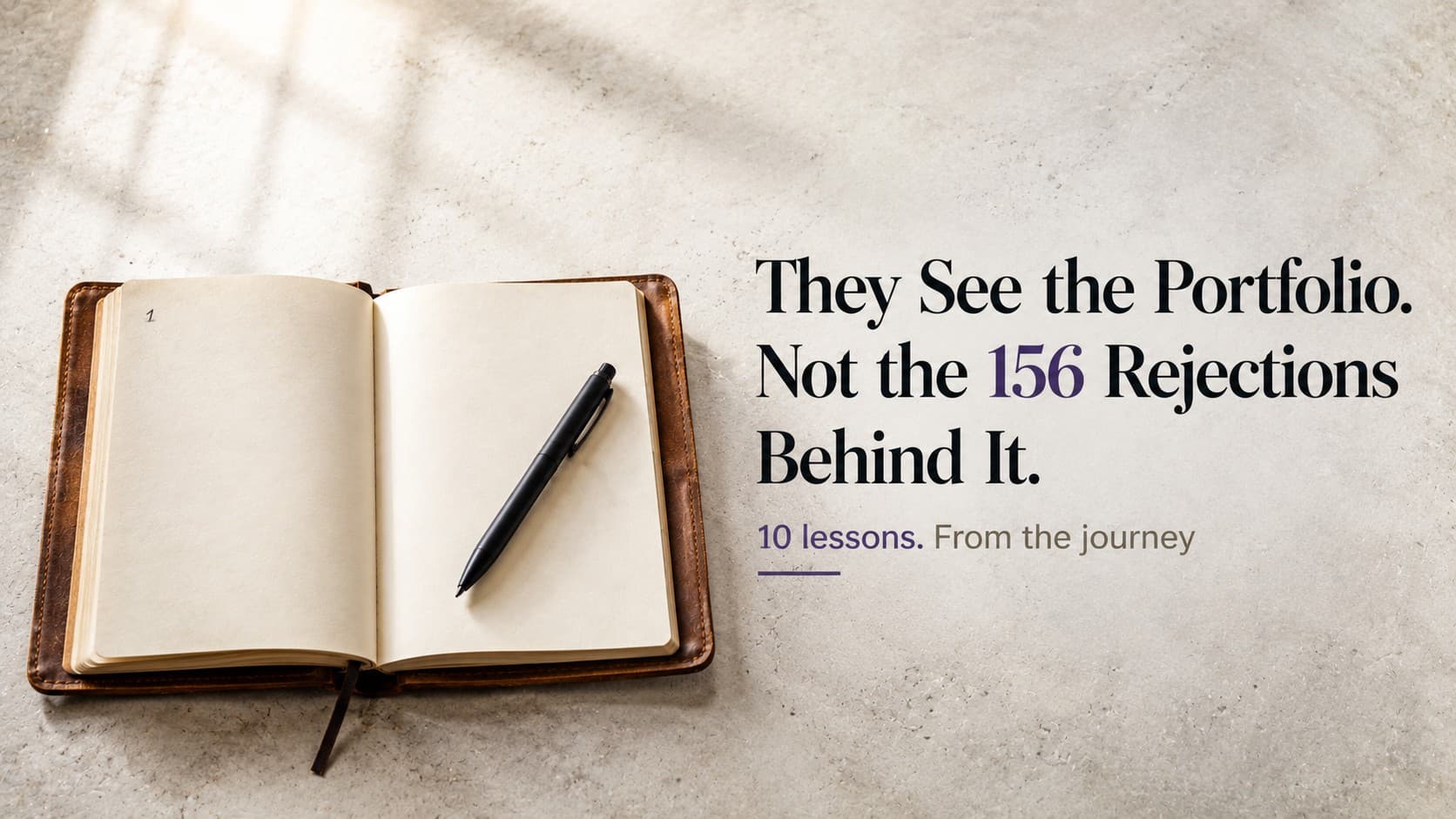
Most people see the property portfolio and the multiple businesses.
But they didn't see the 156 rejections I had to swallow first.
I came to Australia as an international student with a dream. Since then I've lived in three cities, worked every unglamorous job you can imagine, and learned that success looks nothing like what I thought it would at 15. The honest version of any journey is messier than the version people post about. These lessons are the honest version.
Persistence is a numbers game
I applied for 156 jobs with custom resumes before I got my first yes. Most people stop at ten and call it bad luck.
Every rejection narrowed the gap. I kept adjusting the approach without changing the direction. That discipline — effort without panic — is the same thing that eventually gets you to the right outcome in almost anything.
You only need one "yes" to change your life. The number before it is just the price.
The "Corporate Dream" can be a trap
I got the mid-senior role, the nice car, the house. And then I sat with it and realised I was still just a cog. The performance review still decided my ceiling. Someone else still owned my Monday mornings.
The moment I stopped measuring success by what I had and started asking how I was spending my actual time, everything shifted. True freedom isn't a title. It's when you stop trading your hours for someone else's approval.
Work on your business, not in it
I used to be a one-man army. I was insecure that clients only wanted to deal with me personally — and I mistook that for a compliment. It was a ceiling.
The day I brought on someone better than me at something I used to do myself was uncomfortable. But that discomfort was the price of growth. If you can't step back from your business for two weeks without it falling apart, you haven't built a business. You've built a job with extra stress.
Feed the "King" inside you, not the fool
You are the average of the three people you spend the most time with. I stopped spending time with people whose main hobby was gossip, and started building friendships with people who had already done what I wanted to do.
This isn't about being elitist. It's about recognising that your environment shapes your standards — quietly, without you noticing. Protect what you let into your head the same way you'd protect anything else that matters.
Property is a strategy, not a tax hack
The default advice in Australia is to buy property to cut your tax bill. That's not a wealth strategy — it's an accounting shortcut that leads people into the wrong assets for the wrong reasons.
I've watched people pass on properties that would have built serious equity because the suburb didn't sound impressive at a dinner party. And I've seen others build real wealth in places nobody was talking about, because the fundamentals were right. Don't follow the herd. Talk to someone who actually looks at the data first.
Money should work for you
Most people believe money is only earned through hard work. Very few realise it can work on their behalf — growing in the background while they sleep, compounding on an asset they bought years ago.
Your time is finite. Your capital, deployed correctly, isn't subject to the same limit. That's the whole premise behind building a property portfolio rather than just saving a salary and hoping the numbers add up one day.
Parenthood is the hardest "startup"
I have run multiple businesses and managed mortgages across several states. Parenting is harder than all of it.
There is no playbook, no advisory board, no precedent you can point to. Every child is different. You can read every book and still get it wrong. The only thing I've found that actually holds up: show up, be present, and stop pretending you have it all figured out — because they can tell when you're performing.
Ethics matter more than clickbait
I've seen people use war footage, manufactured urgency, and dollar signs to move property courses and investment products. It makes me angry — not because it's annoying, but because it preys on the people who can least afford to make a bad call.
The property industry has a trust problem that it largely created itself. The way out of it isn't better marketing. It's telling people the truth, especially when that truth isn't what they want to hear. That's the only way to build something that lasts.
Don't hide the "unglamorous" parts
I'm honest about my failures — the rejected pitches, the times I genuinely didn't know if things would work out, the fear of starting a family during COVID with no certainty about what was coming next.
People sense when you're only showing them the wins. They can't always articulate it, but it creates distance. Honesty about the hard parts builds more trust faster than any highlight reel ever could.
Find your "unorthodox" de-stressor
Mine is making kebabs, barbecuing, or running a business meeting on the sofa while playing FIFA. It doesn't look serious from the outside. It works.
Sustained performance isn't about how many hours you log. It's about how deliberately you recover. The people who last longest in high-pressure environments are almost always the ones who figured out how to genuinely switch off — before they had to.
I'm still a dreamer. I still don't have it all figured out.
But I'm learning every day — and I think that's the point.
Which of these resonates most with where you are right now?
Ready to put your money to work?
If lessons five or six hit closest to home, let's have a real conversation about what a property strategy looks like for your situation.
Talk With Our Team →This article reflects personal experiences and opinions only and does not constitute financial, investment, or legal advice. Property investment involves risk — always seek independent advice before making financial decisions.