
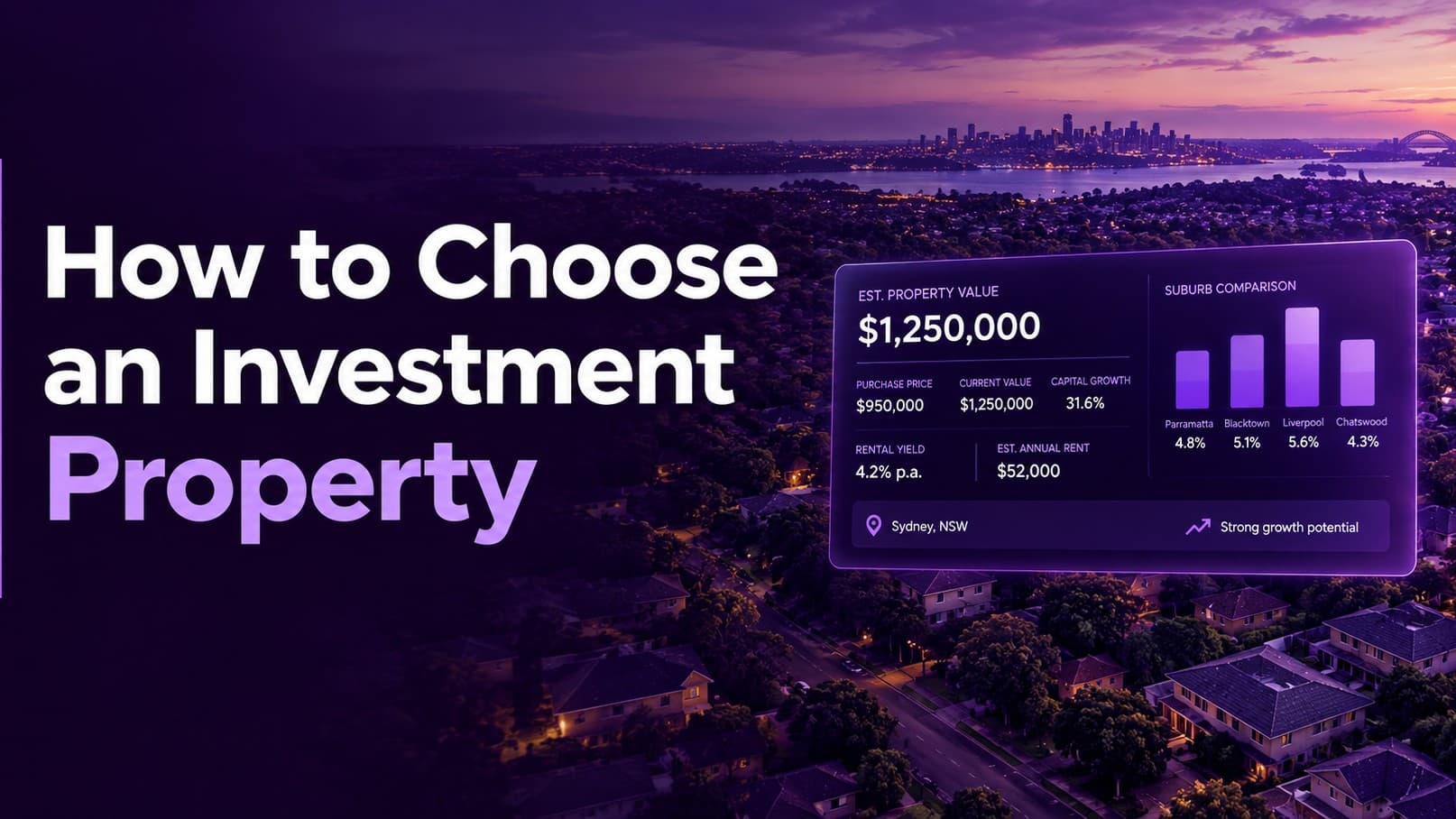
You choose an investment property by starting with the right market, screening the property against real numbers, and completing due diligence before making an offer. Since 2022, Prime Pursuit Properties has purchased properties across several Australian markets — and the lessons from those purchases have stayed consistent regardless of location or price point.
Start With the Right Market
Before choosing an investment property, decide which market fits your property investment strategy.
Australia does not have one property market. Different cities, regions and suburbs can have different economic and property conditions.
National headlines provide broad context, but local conditions can vary significantly.
Your budget and investment goals should also guide which markets and property types you consider.
At Prime Pursuit Properties, our experience across different markets has highlighted the importance of choosing the right market before selecting an investment property.
Analyze Local Market Before Choosing a Property
Once you identify a potential market, it is worth looking more closely at its local conditions.
Before considering a property, look at:
Supply and demand: Is there enough demand for the available housing? Affordability: Can local buyers and renters afford properties in this price range? Employment: Are local industries and jobs supporting the area? Population: Is the local population growing or changing? Rental demand: Are people actively looking for this type of property? You do not need one perfect statistic. Look at several indicators together to understand the market more clearly.
Screen the Property Before You Buy
Finding a suitable market is only the beginning. The individual property also needs to make sense at the price you are paying.
Two properties in the same suburb can have very different investment potential because of their land size, condition, property type and improvement potential.
Look Beyond the Listing
A low asking price can make a property look attractive. In one case, we assessed a $760,000 property in Berwick after it was repossessed by the bank.
The property initially appeared to offer renovation potential, with an estimated renovation cost of around $100,000 to $150,000. After inspection, that estimate increased to around $200,000 to $250,000. One room also appeared to be unapproved and potentially required demolition.
The inspection changed the numbers and changed our view of the investment.
Before considering a property, check:
- Purchase price
- Land size
- Property condition
- Property type
- Renovation potential
- Comparable properties
- Potential end value
Depending on the property, additional building, planning, legal, or environmental checks may also be required before proceeding.
Test the Renovation Numbers
Renovation can add value when the property has suitable characteristics and the costs are realistic. It should not be treated as guaranteed profit.
Start with a simple total cost:
Purchase price + renovation cost = property cost before other costs
Then compare that total against comparable properties in the immediate area.
A property should not be selected because its initial price looks low. The finished property still needs to make financial sense after renovation costs are added.
Complete Due Diligence Before Making an Offer
Before making an offer, check whether the property's price, condition, costs and potential still support the investment case. This is a key part of investment property due diligence.
Use the information from the listing, comparable sales and property inspection to update the numbers before making an offer.
Do not let a discounted listing or buyer pressure replace proper due diligence.
For a closer look at how this process works in practice, see our property acquisition and due diligence process.
Due Diligence Checklist
| Check | What to Confirm |
|---|---|
| Price | Does it compare reasonably with similar properties? |
| Condition | Are there issues that could increase costs? |
| Renovation | Are the estimated costs realistic? |
| Comparable properties | What are similar properties selling for? |
| End value | Does the immediate area support the expected value? |
| Rental | Is the expected rent supported by comparable properties? |
| Total cost | Does the investment still make sense after expected costs? |
Learn From Real Property Investment Results
Prime Pursuit Properties' purchase data since 2022 gives us a practical record of how different markets and properties have performed. The results have varied across locations and purchase periods.
This allows us to compare broader regional performance with the results of the individual properties we purchased.
What Our Purchase Data Shows
| Purchase period | Markets | Reported regional growth | Reported client property growth |
|---|---|---|---|
| 2022–2024 | Bunbury region, WA | Around 60% | Around 80% |
| 2024 | Gladstone, Townsville, Mackay | Around 15–20% | Outperformed regional averages |
| 2024–2025 | Shepparton, Melbourne areas, Wagga Wagga, Albury/Wodonga, Cairns | Around 15–20% | Around 20–30% |
| Late 2025–2026 | Mildura, Bendigo, Warrnambool | Around 10% | Reported to outperform regional growth |
| March 2026 onwards | Fraser Coast, Southern Grampians, Tasmania, Swan Hill, Parkes and other areas | Around 7–10% | Reported to outperform regional growth |
The results above are based on Prime Pursuit Properties' purchase data. They reflect past outcomes and should not be treated as a guarantee of future performance.
Why Investment Property Selection Matters
Our research and experience show that selecting the right property remains important even within a suitable market.
Across the purchases reviewed, we generally focused on established homes with larger land sizes and potential for improvement. Units and townhouses were generally avoided.
This experience highlights the importance of assessing both the market performance and the property characteristics that make a specific property suitable within that market.
This data also shows why market growth alone is not enough. Properties in the same market can perform differently based on their price, location, land size, and other characteristics.
Past capital growth provides useful context for reviewing our previous purchases. It should not be treated as a prediction of future performance.
You can also see how these principles fit into the wider Prime Pursuit property investment approach.
Consider Rental Demand Alongside Capital Growth
Rental demand is another factor to consider when assessing an investment property in Australia.
Check whether the property type is suitable for local renters and whether the expected rent is supported by comparable properties.
Calculate Rental Yield
A simple gross rental yield calculation is:
Annual rental income ÷ purchase price × 100 = gross rental yield
For example, a $600,000 property renting for $600 per week generates $31,200 annually.
$31,200 ÷ $600,000 × 100 = 5.2% gross rental yield
This is only a starting point. It does not include vacancy, management, maintenance, financing, or other ownership costs.
Rental yield should therefore be considered alongside the purchase price, property condition, ownership costs, and potential capital growth.
The goal is not simply to find the highest rental yield. It is to understand whether the rental position supports the overall investment case.
Do Not Let Market Headlines Make the Decision
Property forecasts can provide useful context. They can also change as economic conditions change.
Our experience since 2022 includes purchase decisions made during periods of concern about the broader Australian property market.
This does not mean forecasts should be ignored. They can highlight important risks and help investors test their assumptions.
The final assessment should come back to the property itself:
- Where is it located?
- What are you buying?
- What will it cost?
- What evidence supports the investment case?
- What could change the numbers?
This keeps the focus on the specific investment property rather than trying to predict the entire Australian property market.
Review the Numbers Before You Buy
Before making an offer, review the key numbers together.
- Check the purchase price, property condition, renovation costs, comparable sales, rental estimate, and expected ownership costs.
- Separate known facts from future assumptions. Future capital growth and rental changes cannot be guaranteed.
- Also identify what could change your decision. Higher costs or weaker evidence may be a reason to walk away.
A disciplined property investment strategy means being prepared to change your decision when new evidence changes the investment case.
If you would like help working through this process, our buyer's agent services are available to clients across Australia.
Final Thoughts
In this article, we have shared lessons from Prime Pursuit Properties' experience in Australian property investment since 2022. Our goal is to show how we approach investment decisions, what we look for in a property, and which risks we try to identify before making an offer.
Property investment involves significant financial decisions. Small details can sometimes change the overall investment case. Through our industry experience, we have developed a practical workflow to identify these details, test the numbers, and find opportunities that may otherwise be overlooked.
These lessons can help you assess your next investment property with greater clarity, from the local market and property itself to the numbers behind the purchase.
Frequently asked questions
What is an LGA in property investment?
A Local Government Area is managed by a local council and can include several suburbs. For investors it provides a broader view of housing supply, employment, infrastructure and population before narrowing research to a suburb or individual property.
What factors should I analyse in an LGA before investing?
Supply and new development, local demand and population drivers, rental demand, infrastructure and jobs, and affordability. The strongest cases are usually supported by several of these factors pointing in the same direction.
Is LGA analysis enough to choose an investment property?
No. LGA analysis is only the starting point. After the LGA, the analysis needs to move through the suburb, the specific pocket and the individual property before making any purchase decision.